“… any doctrinal deficiency in our understanding of God’s nature (holiness, sovereignty, omnipresence or omniscience, or omnipotence, benevolence, wisdom, goodness …) will not only lead us into manipulative and vain pilgrimages, but also foster lives that are sadly unaware that God is present everywhere, watching us everywhere and knows everything we do and think, and hears everything that say from wherever we are, all the time. And if it had to take an Ebola outbreak to bring us to that acknowledgement, so be it.”

Disguise – Why would God allow an Ebola Outbreak at such a time?
You have heard or even used that expression: “It is (or was) a blessing in disguise.” What is the blessing? And what is the disguise? On any rainy and flooding day, while Kampalans will be grumbling over poor drainage and loses, majority, if not all farmers across Uganda (who feed Kampala on their produce) will be thanking God for the blessing of water. That’s where I find myself in this Ebola vs. Namugongo stand-off. Could this be a “Blessing in disguise”?
You see in a world of busy schedules and hustle, and especially in a rollercoaster country like Uganda, most public holidays are opportunities to catch some breath. Just like that water point during a marathon. Some use them (public holidays) to catch up on postponed assignments, or even personal projects. We all look forward to them. But 3rd June is a little different. It’s hyped with historical narratives, nationwide preparations, pilgrimage, businesses, religious tourism, special prayers, and even “testimonies” – sometimes very ridiculous testimonies. For the residents of Namugongo, Kyaliwajjala, Kira, Naalya, and all neighbouring places, it can be disastrous. I loathed when I lived Kira some years back!
But this year is different – though not strange. If you will, please come with me to Namugongo. The atmosphere around both the Roman Catholic and Anglican Martyrs’ shrines is somber and dull. No heavy traffic of both cars, no mammoth crowds, no heavy security deployment, no religious tourists, no buzz of mostly opportunistic businesses (ranging from foods and beverages – alcohol and pork, martyrs and related religious artefacts, among others), no long queues, no empty jerrycans on sale – just unusual! As if this is just any other day.
Strange Namugongo – No Crowds and No Usual “Spiritual Vibes”
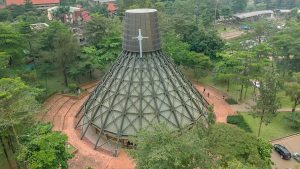
Aerial view of Uganda martyrs Basilica Namugongo – without the mammoth crowds of pilgrims that normally throng the venue every 3rd June.
What happened to God? What happened to those who were meant to trek hundreds of kilometers to come and commune with him and present their urgent and pressing prayer items to him? In fact, it was claimed that during the previous year’s pilgrimage, the clouds opened wide and “Mother Mary” appeared to the pilgrims. In this article, with so much joy, I reflect on what has been lost and gained in the chaos and peace of the cancellation of this year’s celebrations of the Uganda Martryrs’ Day at Namugongo due to an Ebola outbreak as pronounced by the Ugandan government last month.
Well, we live in interesting times, and as it has been said that, apparently, a “political transition of sorts” is already unfolding before us. I’m tempted to imagine an even broader transition – perhaps to include a possible transition in our public theology as well. Whether it’s the public trial of Okello Christopher Otim, or the public display of a certain Rolls Royce through the streets of Kampala, or the public declaration of war against corruption, the dramatic changes in our country’s public governance offices,… , and yeah, the banning of large public gatherings – especially leading to the cancellation of this year’s celebration of Uganda Martyrs’ Day at Namugongo. A lot is going down in our country, and as a Christian, I’m elated at the implications of these events on both conventional corruption in our public (and private) offices and, religious corruption that often goes unchecked!
Every 3rd of June Uganda prepares to receive hundreds of thousands of pilgrims and religious tourists. In fact, it has been said that then Namugongo Martyrs’ shrines (both the Anglican and Roman Catholic) host of millions of both local and international pilgrims over the period of the annual commemoration of the Martyrs day. These preparations usually involve many stakeholders, among them religious leaders, politicians, the government, business people, criminals, and obviously the ordinary programs for whom this is another opportunity to gather with other believers with whom they share the same faith in Christ and camaraderie in identifying with the legacy of fallen heroes of the faith – also known as martyrs.
“Where can I go to get away from your Spirit? Where can I run from you? If I go up to the heavens, you are there. If I lie down in the grave, you are there. If I take the wings of the morning, and dwell in the uttermost parts of the sea, even there you shall lead me; and your right hand shall hold me.” (Psalm 139:7-10)
Blessing – a Opportunity to Rethink our Doctrine of God
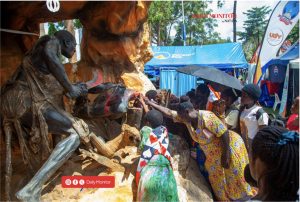
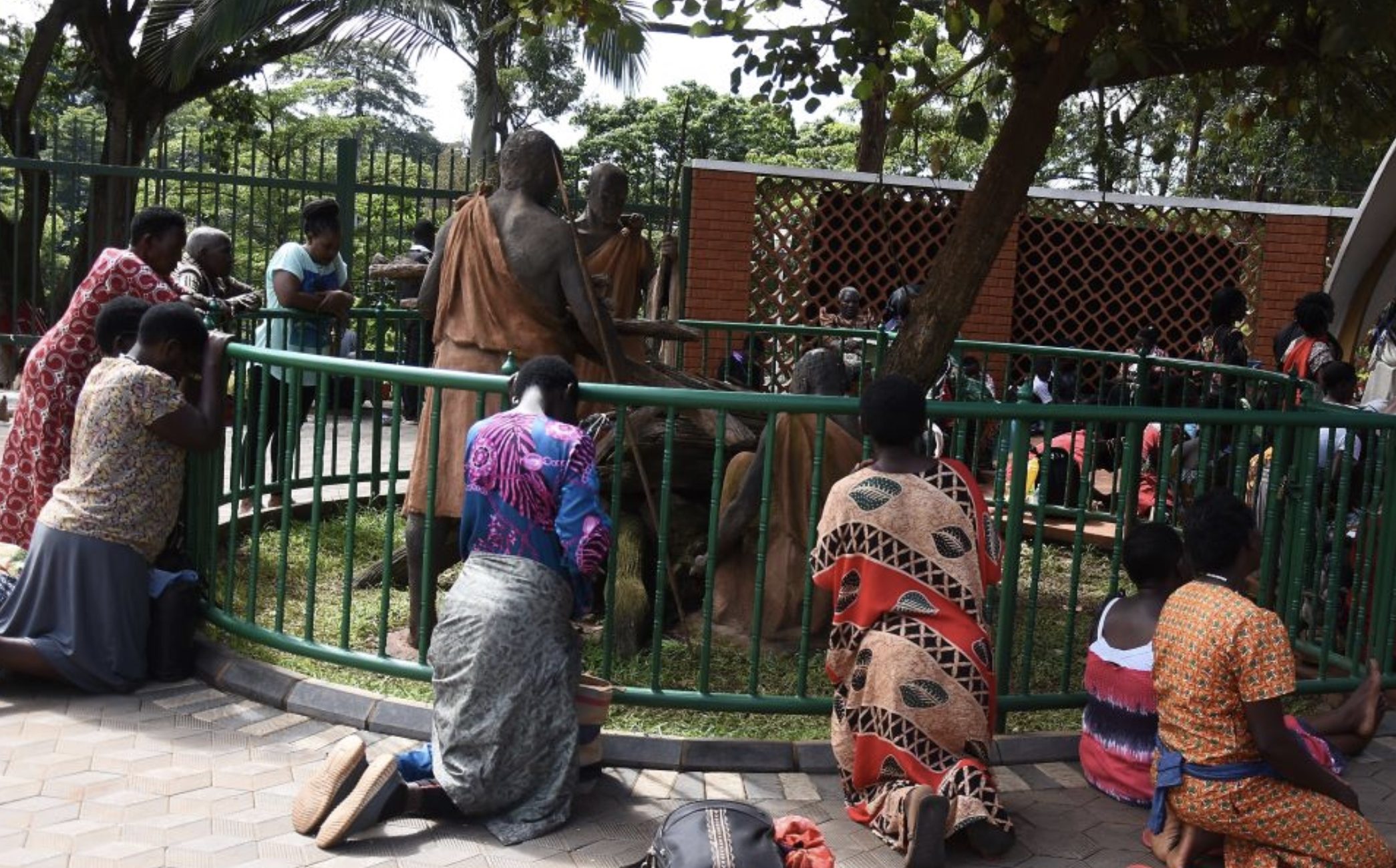
Pilgrims touching animations of the Uganda Martyrs at Namugongo – and praying (DAILY MONITOR)
Over the years, Namugongo has been synonymous with pork, alcohol, crime, long queues with jerrycans of water fetched from the small lake believed a spring in which the executioners of the Uganda martyrs washed their weapons (clubs, knives, machetes) clean of blood. Hence, the pilgrims, believe that the water has holy powers to heal disease and bring blessings into their lives. An annual trip Namugongo is a golden opportunity to collect water to sustain them through the next year as they wait for another year and another year. This time round they may have to wait longer.
Often times pictures from the martyrs’ day events will show pilgrims, bowing before the sculptures and statues of the martyrs (some to their respective martyrs particularly according to their vocations and age groups). They will kneel, bow and touch the animated statues of the martyrs in prayer, beseeching them as saints of God, to deliver their personal prayers and needs to Mother Mary, or to Jesus, whom they believe will then deliver them to God for a desperately needed answer. Why Namugongo? And why the Martyrs? The Martyrs are believed to be holy and having access to the presence of the God-head as saints, and are a sure path or channel for the pilgrims to deliver their pressing prayer needs to God. And Namugongo is more like the contact location – or the hotspot of the spirit of the martyrs or heaven for that matter.
The major theological question that arises is, while the spirit of the uganda martyrs is believed to be at Namugongo, which confirms that it is not omnipresent, is God‘s presence and spirit and power, also restricted to Namugongo? Can a believer pray to God and put before him any pressing need wherever they are in the country or the world? Do I have to walk hundreds of kilometer from Nebbi, Kapchorwa, Kotido, Mbarara, Kasese, Congo, Dodoma, Nakuru, or from Juba, to Namugongo, in order to obtain the services of the martyrs as agents of God who collect people’s prayers and take them to Him? What if I can’t make it to Namugongo for one reason or another? Is it even fair that some believers only come from Kampala and Neighbourhood? What about the high-ranking church leaders like bishops and archbishops who never walk but drive to the pilgrimage sites (a.k.a Martyrs’ Shrines)? If I were to hold the same pilgrimage at any other point in the year, will the spirit of the martyrs attend to me in the same way as when we gather in millions on 3rd June?
“Thus says the Lord: “Heaven is my throne, and the earth is my footstool; what is the house that you would build for me, and what is the place of my rest?” Isaiah 66:1
Blessing – a time to Rethink Pilgrimage.
Which brings me to the main purpose of this article; does it have to take another Ebola outbreak, and government ban on large gatherings to realize that this thing we have been doing for decades is not only spiritually unhealthy but also unbiblical – and a hoax? Didn’t we learn anything from the two years (2020 and 2021) when we didn’t gather in Namugongo to commemorate the said martyrs because of the COVID-19 pandemic? Why does it have to take epidemics to remind us of the basic doctrines of the Christian faith, such as God, His sovereignty, omnipotence, and his Omnipresence?
Now that this year celebrations will not be gathering millions at Namugongo because of the threat of the Ebola outbreak in neighbouring Congo, the respective organizing denominations have rather decentralized the commemoration prayers to the local parishes and dioceses, since we still have the public holiday. Why exactly didn’t we think that this decentralization and scientific Celebrations are much cheaper, reasonable, and even theologically healthier thing to do all along? How much time and money will we be saving for individual, families and the economy at large, by students and adults not being away from school and work just because they have to walk hundreds of kilometers for days to Namugongo? Every year we insist on gathering at Namugongo, we paralyze its Neighbourhoods for close to a week (Kira, Kyaliwajjala, Naalya, Mbalwa …), except for some business people that make a kill.. Our workforce is short of labor, and our students fall behind on the academics. It could be a blessing in disguise that this time an Ebola outbreak is causing us to reflect, revisit, and reconsider how we might want to do this thing going forward.
My prayer this year is that wherever believers will gather across the country they will celebrate, commemorate and reflect on the faith and example and legacy of the Uganda martyrs. They may not be able to hand their urgent prayer needs to the animated martyrs’ statues at Namugongo, which they honestly don’t need to, but even if reluctantly, I hope they make even an attempt to imagine that the God whom they were hoping to contact from Namugongo can actually be reached from anywhere and everywhere – because he is omnipresent! Yes, finally, God will be treated in accordance with his true nature – omnipresent and omnipotent, especially by those who always knew it but preferred to make profit from religious corruption disguised as tourism, and pretending and teaching otherwise.
“There’s not a single square inch of creation, and the whole domain of our human existence, over which Christ, who is Sovereign over all, does not cry: ‘Mine!” – Abraham Kuyper, 1880
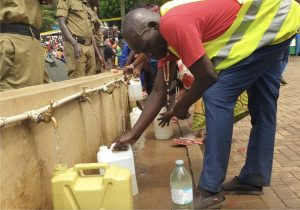
Pilgrims fetching Miracle-working water (Holy & Powerful) at Namugongo.
Unfortunately, there have been some loses registered, especially financially. It is believed that annually pilgrims bring in and spend tens of billions of shillings over the commemoration period. So, on the reverse-economic side of things, we can’t deny that. But are there more important gains to be grateful for compared to the financial losses and vibes missed this year? Obviously, for those who were planning to receive this year‘s pilgrims at Namugongo, they’ve been left to enjoy an almost regular and much calmer church service atmosphere, and apparent martyrs’ spirit, and miracle water, alone. Even more, perhaps, with a candid opportunity to imagine a better theology. A theology that voluntarily acknowledges, appreciates, and teachers goes to nature as sovereign, omnipotent, omnipresent – powerful and present in all places at all times throughout the year and throughout history.
This is very critical for the church going forward. Our Doctrine of God both informs our practices (such as pilgrimages) and exposes our terrible theologies. As American Systematic Theologian Paul Tripp has argued in his book on Christian Doctrines: “Do You Believe?”, “… all humans live God-referenced lives. What we claim to know (or not know) and believe (or not believe) about God shapes a lot of how we live and our practices.” For example, any doctrinal deficiency in our understanding of God’s nature (holiness, sovereignty, omnipresence or omniscience, or omnipotence, benevolence, wisdom, goodness …) will not only lead us into manipulative and vain pilgrimages, but also foster lives that are sadly unaware that God is present everywhere, watching us everywhere and knows everything we do and think, and hears everything that say from wherever we are, all the time. And if it had to take an Ebola outbreak to bring us to that acknowledgement, so be it.
Hallelujah what a blessing in disguise! And we can only thank the sovereign Lord that this year’s Uganda Martyrs’ Day Celebrations aren’t happening at only Namugongo, but across the whole country – history is being made today! We continue to pray that all religious corruption, perpetuated by such misleading and misrepresenting gatherings face the same fate – for example the one scheduled to bring the Holy Spirit to Uganda later in June.
Blessing in Disguise
The ball is now over to those who be preaching at the various smaller gatherings across the country, and perhaps the world over. What kind of Gospel will they preach? And what kind of God will they pray to and point the people to. I hope we are altogether challenged and compelled to rethink pilgrimage and its spiritual value in view of the Cross of Jesus, and God’s omnipresence and omnipotence, now that we seem to have them activated them in Uganda. Ultimately, it’s a win-win situation for country and church – with no mammoth crowds Namugongo this year, we have healthy population and hopefully, a theologically much healthier church going forward.
~ Raymond L. Bukenya ~
Writer, Speaker & Team Leader Tru Tangazo Uganda
Related Articles