


“ …. what king, going out to encounter another king in war, will not sit down first and deliberate whether he is able with ten thousand to meet him who comes against him with twenty thousand?”
~Luke 14:31~

Head on a Platter – The Art of Counting the Cost “Safely” to Avoid it.
A couple of years ago, I was privileged to be at a Church leaders’ gathering where a particular leader made remarks that still haunt me to this day. He said that “… though John the Baptist had been a great prophet and evangelist, his head ended up on a platter. It is not my path to also have my head on a platter, and I wouldn’t wish it for any of you. Because when I look around, most of you are young, with young families and a future ahead of you. But if any of you wishes, as do some of you, I will not stop you!” With this, the leader cautioned all to be careful in our criticism of the powers that be.
For those not very conversant with John the Baptist’s story, he is a Biblical hero, a loner of sorts. The only son of Zechariah and Elizabeth, cousin and forerunner to the Messiah, Jesus Christ of Nazareth. The Gospel writer, Luke, records that his head ended up on a platter because he failed to bow it. He “carelessly” courageously and firmly called out Herod’s immorality (and wickedness – Luke 3), which, in the setup, would have inevitably meant either bowing and keeping his head, or as he did, raising it and losing it. What was wrong with a godly man like John the Baptist? Did he lack the relevant discernment and wisdom in the times? Or was he just showing off to prove to the others how fearless he was? Was he just a careless man who didn’t even have family?
At face value, the senior clergyman’s caution seems loaded with wisdom. However, a critical look should raise grave concern. If this is the church leaders’ attitude towards the need for prophetic voices against injustices and immorality in our nation, it is likely representative of the church as a whole. If the leaders can’t be counted on to bear the cost of the prophetic call on the church, then who will? It is quite ironic that we have become comfortable with the notion that only a select few believers are called to bear the whole cost of being Christ’s disciples, while the others have the liberty and luxury to choose and pick which cost to bear or to smartly and “safely” avoid.
We seem to disregard the examples seen throughout scripture and history. Think of prophets like Amos – who even with opposition from Amaziah the priest who was feeding from the king’s spoon, and the threat of expulsion, was not deterred from denouncing the idolatry, gluttony and injustice of Israel’s leaders. Think of John the Baptist. Think of the Apostles. Think of Janaani Luwum. Men who, having counted the cost, carried their crosses and followed Christ, who himself demonstrated the same on the Cross.
“It is quite ironic that we have become comfortable with the notion that only a select few believers are called to bear the whole cost of being Christ’s disciples, while the others have the liberty to choose and pick which cost to bear or to wisely avoid.”
Remembering the Late Abp. Janaani Luwum.
It almost comes natural for me to imagine that for a nation like ours that commemorates the Late Janaani Luwum, we also ought to emulate him – especially the church. Even more, church leaders who succeeded him, and lead prayers at his commemoration. However, in similar vain as the church leader’s caution mentioned earlier, another leader advised further, this time directing it to me personally, that; “If you really are passionate about matters of justice in this country, find like-minded church leaders with whom you share this calling and author these pieces together so that it is not your individual name that’s on them. Otherwise, you put your life and your loved ones in jeopardy.” Words of wisdom? Who wouldn’t want to play safe? Count the cost first before raising that head and voice. Else, it ends up on a platter. In the meantime, bow it and mumble.
Luwum was naïve to stand up to Amin and his regime, writes a commentator, because the repercussions were obviously severe. The commentator candidly wrote, “Luwum got what he asked for.” If I understood the caution, Luwum’s fate seems to suit those trying to ‘play hero,’ raising their heads before their (religious) leaders and speaking against the injustices and immoralities – the sin of our society and its leaders.
Given the large crowds and chaos of our time, raising their head and voice would cost much. It costs less to do the opposite – just bow your head and safely remain part of the crowd. Bowing one’s head can come off as a sign of reverence towards the king. But it can also be out of genuine fear, timidity, or sadly, as I suspect, out of hypocrisy and a means of survival. You see, hiding one’s identity and mummer with a bowed head is easier. But once you raise it high amidst the crowd, you are identified and become a target. And you had better be ready to count and pay the cost.
“Scripture and history are awash of examples of those who both counted and paid the cost of true discipleship. Not that a few brave ones in our times might find them inspirational and emulate them, but that all believers might find in their stories, the reassurance that the same God who called them was with them, and He is calling and is with us too.”
Many presume that counting the cost is so that one might find a justification for cheaply bowing head and backing off. But what if counting the cost actually meant understanding the true weight and value of raising one’s head and voice for the voiceless amidst the chaos and rampant injustices in our society? Jesus raises a Biblical principle in Luke 14:25-33, citing examples from discipleship, construction projects, or even war. One ought to work out the math of the real cost before committing to or embarking on a project or going to war.
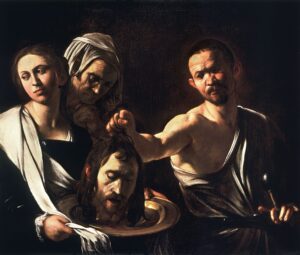
John the Baptist’s head own a Platter, presented to Herod by his daughter Salome. By Caravaggio – Self-scanned, Public Domain
In context, Jesus is telling his listeners that the decision to follow him would have to be rational and comes at a cost––denying oneself and picking up ‘a personal cross,’ which is precisely what the Christian faith is about – not a blind leap or hereditary as some have imagined and argued. Sadly, that’s what the church has taught and depicted. No wonder I hear people claiming to have skeptically walked away from it, towards Agnosticism and Atheism.
More importantly, Luke wants to draw our attention to Jesus’s central thesis to his listeners: God, their redeemer, is aware of the battle in redeeming and reconciling his people to Himself. The sacrifice, not of lambs or bulls, but of him only Son. John writes that Jesus lovingly and willingly lays down His life for those He Loves. In John 3:16, it’s declared as Love for the whole world. Not as we love it, but as He loves it, including us. In fact, He has worked out the cost, and nothing will stop him from paying it in full (see Matthew 20:28, Mark 10:45, John 13:1-17, and Paul in 1 Tim 2:5-6).
Interestingly, it’s for that reason that many were drawn to follow Jesus and have continued to do so throughout history. It is also why Christians remember Him for his body that was broken and shedding of his blood, that sinners like you and I may find salvation and that the whole world might experience God’s transformation and renewal. It comes at a cost – death. A cost that was counted and not avoided but bravely and lovingly embraced and paid in full! Sadly, inevitably, church leaders’ posture in times like the ones in which John the Baptist and Janani Luwum lived influence and shape the church’s general attitude and posture. I have witnessed this in the cautious language by younger church leaders, as one recently remarked;
“I have a very young family, a house, my children are in school, and I have my small car. I have gains to protect!”
They Counted the Cost and Paid it – in Full!
How do we even express fear of death without confirming that those whom we fear are capable of killing us? Let alone legitimizing their monstrous behaviours and untouchableness! When considering the seriousness of what is at stake, one can’t help but see the cloud of witnesses throughout scripture. For instance, Daniel’s friends, Meshack, Shadrach and Abednego, refused to bow down and worship king Nebuchadnezzar’s golden image even when the cost was made clear to them––the fiery furnace. Wouldn’t it be relatively both spiritually immature and disrespectful of these witnesses, the prophet Amos, John the Baptist, or Janani Luwum, to imagine that they were naïve and didn’t count the cost of their decisions to not bow their heads?
Whether we deem our times similar to, or more complicated and dangerous than Amin’s or those described in Amos or Luke 3 about John the Baptist, do we have the wit to mention ourselves in the same sentences with them? What do we claim to have in common with an Elite league of brave and courageous men of faith? We are mere cowards who live for convenience, which is evidence against our overly hyped shallow spirituality.
“… do we have the wit to mention ourselves in the same sentences with them? What do we claim to have in common with an Elite league of brave and courageous men of faith? We are mere cowards who live for convenience, which is evidence against our overly hyped shallow spirituality.”
For example, we seem to have positioned one over the other regarding our prophetic call, prayer and fasting. We work so hard at fasting and prayer. We fast 40 days at the beginning of each year so that we can hear God’s direction for the New Year, only to be indifferent about the decay in our nation every year. We are clueless and timid about how to be the prophetic voice God has called and positioned us to be. Now Lent is here, and as pious traditionalists, we have received the cross of ash, empowered to go before God with our sacrifices of denial of self-indulgence. But whatever we do, in a nation where injustices, immorality, and corruption have become the norm, what God requires of us (Micah 6:6-8) is simple, though costly, and cannot be left to ambiguity, or whether the prophets’ mouths have the king’s spoon in them or not?
The times might differ, but God’s stance on injustice and immorality is unwavering. His expectation of the church is always the same from generation to generation and all nations. And I might dare say that for a country like Uganda, which is said to be over 85% “Christian”, together with the continent of Africa and the Global South, which is believed to be the Center of Christianity in the 21st Century, the standard is even possibly higher. Unless that status is artificial – a pseudo-spirituality!
If we bow our heads, we will keep and even feed from the king’s table and have our mega projects funded from the king’s treasury. But if we dare to raise them, kings are always kings and often have dancing daughters. Kings also get drunk on the cup of power and pleasure. Somehow, we know that that will end us, our families, our legacies, and everything we had achieved after sacrificing “everything”. We know what’s at stake – what we stand to lose or gain. While God is said to be King, we hope he can himself go to war with these kings. That’s not our battle. Ours is to survive.
But can our heads take a posture that our hearts aren’t fully convicted about? Bow or raise, the state of our hearts determines the posture of our heads, for out of the abundance of the heart, the mouth speaks (Luke 6:45). Being that our prophets’ heads are bound to the state of their hearts, our expectations of them ought to consider how much we know about their hearts, mouths, and stomachs––whether historically or presently.
“But can our heads take a posture that our hearts aren’t fully convicted about? Bow or raise, the state of our hearts determines the posture of our heads”
We Counted the Cost, so we could “Smartly” Avoid it.
Would it be spiritually wrong if the Church chose to pray that God would revive it to produce more Luwums for our times? Not that they should die while standing up for their godly convictions, but that they would not silently and indifferently play safe, even when their lives and survival depend on that. The Amoses, John the Baptists, and Janani Luwums of this world did not rise out of the blue but were raised by God at a specific time for His divine purposes. The same God has raised disciples, and He’s calling them to not only count the cost and “wisely” evade it but rationally, joyfully, and willingly embrace it for His Glory.
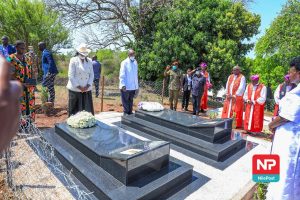
Uganda Political and Religious Leaders lay wreaths at the grave of St Janani Luwum and his wife at St. Paul Church of Uganda in Mucwini sub-county, Kitgum district, during today’s 49th commemoration of #JananiLuwumDay. (PHOTO CREDIT: Nile Post)
But does the church feel called to stand to the task of Janaani Lumum and count the cost of proclaiming the gospel with its full implications in the face of injustices, immorality and corruption? Isn’t commemorating Janaani Luwum with a gluttonous State––a State that arrogantly sheds the blood of innocent citizens, oppresses those who disagree with it, rewards the corrupt that are loyal to it––conforming with the pattern of the state itself and dishonouring to his sacrifice and legacy? We have tactfully mastered the reverent art of keeping safe by counting and avoiding the cost.
Another Janaani Luwum Day is here. As I ponder the cautionary words of the church leader I mentioned at the beginning, I wonder: Has the church truly grasped the cost of discipleship and its prophetic call? Did the Janaani Luwum we commemorate this day count the cost? Or did he not? How come it did not deter him from exercising his prophetic call? Does the church care to intentionally disciple the Luwums of our time? And, where are the men and women who have counted the cost and are willing to raise their heads?
Isn’t commemorating Janaani Luwum with a gluttonous State––a State that arrogantly sheds the blood of innocent citizens, oppresses those who disagree with it, rewards the corrupt that are loyal to it––conforming with the pattern of the state itself and dishonouring to his sacrifice and legacy?
What, then, can the church do, consider?
The church is left to consider some costly and challenging steps, and I propose it may be in not inviting the king to this commemoration which he himself granted. Or, in knowing that the king’s frequent gifts to the church come with control, refrain from them? How about corporately repenting and mourning our sins as a country? Or, instead of raising monuments and buildings in honour of Luwum, let’s institutionally raise and disciple all believers everywhere so that the whole church has a prophetic presence and voice in our nation. These will come at a massive cost of trading off the benefits of conformity. But this way, bowing heads ceases to be the norm, and no individual believer is afraid of being targeted, isolated, or losing their head. In my view, this honours the blood of saints like Luwum and glorifies our Lord Jesus Christ, who preserves our heads now and eternally.
~ Raymond L. Bukenya ~
Writer, Speaker & Team Leader Tru Tangazo Uganda

